
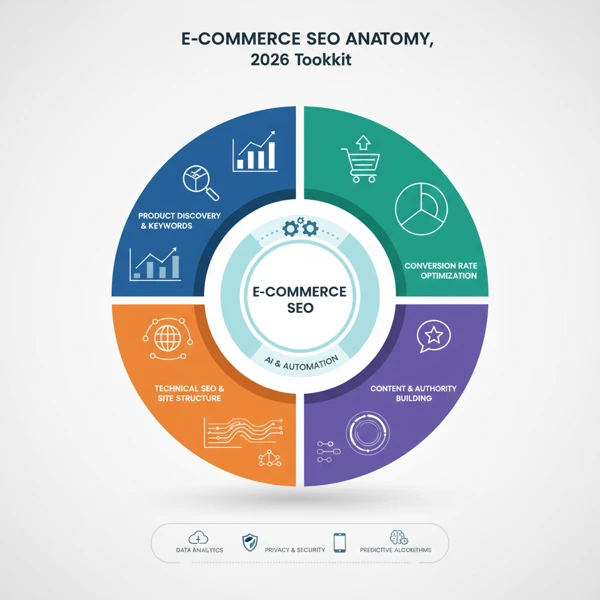
The Anatomy of SEO: Breaking Down the Core Components
The world of e-commerce moves fast, and staying visible amidst the digital noise is more challenging than ever. In 2026, simply stuffing keywords isn't enough; you need a sophisticated, user-centric approach to capture attention and drive sales. This isn't about chasing algorithms; it's about building a digital storefront that genuinely serves your customers and earns trust.
Many small business owners feel overwhelmed by SEO, but what if you could break down its complexity into manageable, even automated, components? This guide will demystify the core anatomy of modern e-commerce SEO, equip you with an essential toolkit, and show you how to build a robust foundation that propels your online store forward. Get ready to transform your approach and see real results.
Beyond keywords: understanding SEO's core structure
Forget everything you thought you knew about SEO being a game of keyword stuffing. In 2026, SEO is fundamentally about fulfilling user intent and providing an exceptional online experience. It's a complex ecosystem of technical prowess, content relevance, and brand trustworthiness. If you're running an e-commerce store, understanding this evolution is your first step towards sustainable growth. For a deeper dive into the basics, check out our guide on what is SEO and why you should care in 2026.
"The evolution of search algorithms from 2025 to 2026 highlights a major shift towards understanding the context and quality of content, emphasizing user satisfaction above all else."
Google's shift: prioritizing helpful, people-first content
Google's core mission is to deliver the most relevant and helpful results to its users. This means their algorithms are constantly evolving to identify and reward content that truly satisfies user needs. For e-commerce, this translates to creating a seamless, informative, and delightful shopping journey. It's not just about getting clicks; it's about providing the best answer or product for every search query.
This focus extends to AI-generated content as well. The question isn't "Does AI content rank on Google?" but rather, "Is AI content helpful, reliable, and people-first?" If your AI content is well-researched, accurate, original, and edited to meet high-quality standards, then yes, it absolutely can rank. Google's guidance on creating helpful, reliable, people-first content emphasizes:
- Content should be created primarily for users, not search engines.
- It must demonstrate first-hand expertise and provide original insights.
- Ensure content is comprehensive, accurate, and clearly sourced.
- Your site's purpose should be clear, leaving users informed and satisfied.

E-E-A-T: building trust and authority in e-commerce
Google's E-E-A-T framework (Experience, Expertise, Authoritativeness, and Trustworthiness) is more crucial than ever, especially for e-commerce sites. It's how Google assesses the credibility and reliability of your online store and its content. Demonstrating first-hand expertise means showing you truly understand your products and your customers' needs.
So, how do you infuse E-E-A-T into your product pages and category descriptions? It's about more than just words; it's about signals:
- Experience: Share customer reviews and user-generated content, showing real people are using and loving your products. Use high-quality product images and videos that provide a clear view.
- Expertise: Provide detailed product specifications, usage guides, and comparisons. If you manufacture or curate, highlight your knowledge of the craft or industry.
- Authoritativeness: Build high-quality backlinks from reputable sources. Mention any awards, certifications, or partnerships you have. Be the definitive source for your niche.
- Trustworthiness: Ensure clear shipping, return, and privacy policies. Provide secure payment gateways. Make customer service easily accessible. Display trust badges if applicable.
Did You Know? User engagement metrics like dwell time and bounce rate are key indicators Google uses to gauge content value and user satisfaction. Higher engagement often leads to better search rankings. (Source: Forbes, 2017)
Staying ahead: algorithm updates and Google's spam crackdown
Google regularly rolls out algorithm updates, some small, some significant. The spam updates, particularly those in March, August, and December 2025, served as a stark reminder against black-hat SEO tactics and manipulative content practices. These updates explicitly target scaled content abuse, such as generating thousands of thin pages or copy-pasted product descriptions.
For e-commerce, this means focusing on quality over quantity and adhering to Google's webmaster guidelines. Attempting to trick the system with low-value, duplicate, or automatically generated content designed purely for search engines is a dangerous game that can lead to significant ranking loss or even removal from search results.
| Google Spam Update | Key Focus | Impact on E-commerce |
|---|---|---|
| August 2025 Spam Update | Scaled content abuse & unnatural links | Penalized sites with thousands of low-value, AI-generated or spun content pages. |
| December 2024 Spam Update | Link spam & manipulative content | Targeted sites using purchased links or producing content solely for ranking. |
| March 2024 Spam Update | Doorway pages & site reputation abuse | Affected sites using deceptive redirects or leveraging strong domains for poor quality content. |
Source: Google Search Status Dashboard, 2024-2025
Your automated e-commerce SEO toolkit
The biggest bottleneck for many small business owners and technical SEOs is the sheer volume of manual work required to optimize an e-commerce store. Think about optimizing thousands of product titles, descriptions, and generating unique, SEO-friendly blog content at scale. It's a daunting task. The good news? Modern tools and smart automation can handle this efficiently, without sacrificing quality or accuracy.

Small business SEO adoption: a competitive advantage
Data based on Forbes, 2017, highlighting a significant untapped opportunity.
Smart automation for product titles and descriptions
Manually crafting unique, engaging, and SEO-friendly titles and meta descriptions for every single product can consume countless hours. This is where AI-powered e-commerce SEO tools shine. They can analyze your product data, target keywords, and even your brand voice to generate optimized content at scale.
The benefits are clear:
- Time Savings: Free up hours previously spent on manual optimization.
- Consistency: Ensure every product listing maintains a high standard of SEO best practices.
- Enhanced Visibility: Attract more clicks with descriptive, keyword-rich titles and meta descriptions.
- Scalability: Optimize thousands of products in a fraction of the time, perfect for growing catalogs.

AI for efficient content generation: blogs and more
Content generation for e-commerce, whether it’s blog posts, category descriptions, or FAQs, is another area where AI is revolutionizing workflows. AI isn't here to replace human creativity, but to augment it, acting as a powerful assistant for SEO content generation for e-commerce. This is particularly valuable for achieving consistent publications.
When used ethically and with human oversight, AI can help you:
- Brainstorm ideas: Generate topics relevant to your products and customer queries.
- Draft outlines: Structure comprehensive articles that cover key SEO points.
- Write initial drafts: Create blog posts, product reviews, or buying guides quickly.
- Optimize for keywords: Ensure your content naturally incorporates target and LSI keywords.
- Maintain freshness: Consistently publish new, relevant content to keep your site dynamic.
Integrating your marketing tools with robust APIs
For both solopreneurs seeking simple, effective solutions and integration specialists desiring clean code, leveraging APIs (Application Programming Interfaces) is a game-changer for e-commerce SEO. APIs allow different software applications to communicate with each other, creating seamless, automated workflows.
This means your SEO toolkit can be integrated directly with your e-commerce platform (like Shopify Plus) or other marketing tools, eliminating manual data transfers and ensuring consistency across channels.
| API Integration Benefit | Impact for E-commerce |
|---|---|
| Automated Data Sync | Product data, inventory, and SEO attributes are always up-to-date across platforms. |
| Streamlined Workflows | Connect your SEO tools directly to your CMS, CRM, or advertising platforms for efficiency. |
| Custom Solutions | Build tailored features or reports using API data, adapting to unique business needs. |
| Reduced Errors | Minimize human error by automating repetitive tasks and data entry. |
This approach provides an affordable SEO solution for small businesses that delivers enterprise-grade capabilities without the hefty price tag.
Building a robust technical SEO foundation
Even with compelling content and automated processes, your e-commerce SEO strategy will falter without a solid technical foundation. Technical SEO ensures search engines can efficiently crawl, index, and understand your site, laying the groundwork for everything else. Addressing these elements not only pleases algorithms but also significantly improves the user experience.

Optimizing for speed, mobile-friendliness, and page experience
Does Google care about mobile-friendliness and page speed? Absolutely! These aren't just ranking factors; they're fundamental to user satisfaction and conversion rates. A slow-loading or clunky mobile site can drive customers away before they even see your products. Google's Page Experience signals, including Core Web Vitals, directly measure these aspects.
For e-commerce sites, optimizing for speed and mobile experience means:
- Responsive Design: Ensure your site looks and functions flawlessly on all devices, from desktops to smartphones.
- Image Optimization: Compress images without losing quality and use modern formats like WebP.
- Minify Code: Reduce the size of CSS, JavaScript, and HTML files.
- Leverage Caching: Implement browser and server-side caching to speed up repeat visits.
- Fast Hosting: Choose a reliable hosting provider that can handle your traffic spikes.

Strategic site structure and powerful internal linking
A well-organized site structure makes it easy for both users and search engines to navigate your e-commerce store. Think of it as a logical hierarchy where related products and categories are linked together. Powerful internal linking helps distribute "link equity" throughout your site, guiding users and crawlers to important pages.
Implement these practices:
- Logical Categories: Organize products into clear, intuitive categories and subcategories.
- Breadcrumbs: Use breadcrumb navigation to show users their current location within the site hierarchy.
- Contextual Links: Link relevant products, blog posts, and category pages naturally within your content.
- Avoid Orphaned Pages: Ensure every page is linked to from at least one other page on your site.
Unlocking rich results with schema markup
Schema markup is code you add to your website to help search engines understand your content more deeply and display it in more informative ways. For e-commerce, this is invaluable. By implementing schema for products, reviews, and prices, you can enable rich snippets in search results, making your listings stand out and increasing click-through rates.
Key schema types for e-commerce include:
- Product Schema: Details like price, availability, and ratings.
- Review Schema: Aggregates customer reviews and star ratings.
- Organization Schema: Information about your business, including logos and contact details.
- Breadcrumb Schema: Helps Google display your breadcrumbs in search results.
Did You Know? Using structured data (schema markup) can significantly improve your visibility in search results by enabling rich snippets. This can lead to higher click-through rates and more qualified traffic.
Assess your SEO readiness
How well-equipped is your e-commerce store to tackle the SEO landscape of 2026? Take this quick quiz to find out!
Your E-commerce SEO Readiness Quiz
Download Your 2026 E-commerce SEO Toolkit
Get the ultimate checklist designed to help you implement and automate your e-commerce SEO strategy for maximum growth in 2026.
Download ChecklistFrequently asked questions about e-commerce SEO
E-E-A-T stands for Experience, Expertise, Authoritativeness, and Trustworthiness. For e-commerce, it's crucial because Google uses these factors to determine how reliable and credible your online store is. Demonstrating these qualities builds customer trust, encourages conversions, and positively impacts your search rankings. For example, genuine customer reviews demonstrate 'Experience,' while detailed product information showcases 'Expertise.'
AI is a powerful assistant, not a replacement for quality. You can use AI for tasks like brainstorming content ideas, drafting product descriptions, generating outlines for blog posts, and identifying keyword opportunities. The key is human oversight: always review, edit, fact-check, and add your unique insights and brand voice to AI-generated content to ensure it's helpful, reliable, and people-first, aligning with Google's guidelines.
Yes, duplicate content can be an issue, especially with product descriptions. If many products have identical or very similar descriptions, search engines may struggle to determine which version is most relevant or authoritative. Use AI and manual efforts to create unique, compelling descriptions for each product. For content that must be similar (like manufacturer descriptions), use canonical tags or ensure unique surrounding text to differentiate.
Extremely important. Page speed and mobile-friendliness are core components of the Page Experience signals that Google uses for ranking. A slow or poorly performing mobile site leads to high bounce rates and lost sales. Optimizing these aspects directly improves user satisfaction, conversions, and your search engine visibility.
Ready to elevate your e-commerce SEO?
Stop guessing and start growing. Our intelligent, automated solutions are built for the demands of 2026.
Get Started with Wudo